
Reviewed · WHALE WATCHING
Whale Watching Maui: 2-Hour Small Group Raft Tour from Lahaina
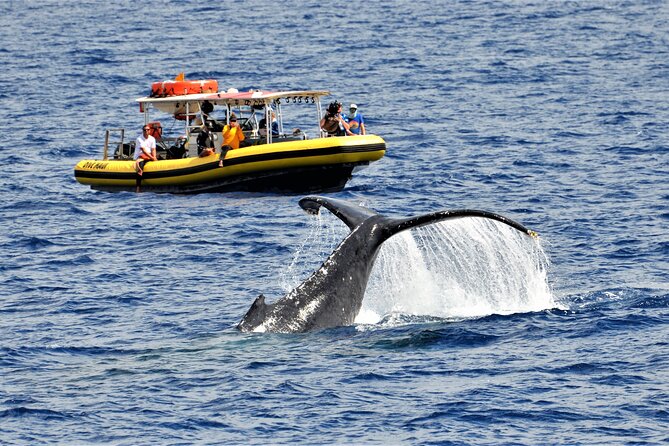
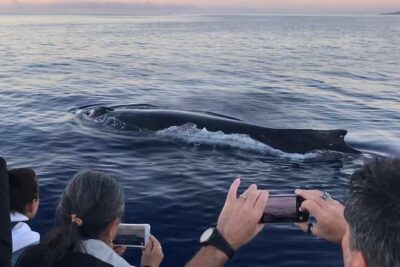
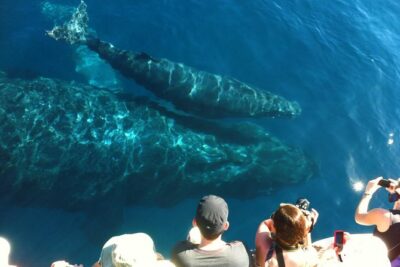
The best part of this Lahaina whale tour is the small inflatable raft, which keeps you close to the water with open views in every direction. You are not staring over rows of heads on a large boat. You can scan for blows, tails, and breaches from nearly any seat, then listen to whale song through a hydrophone lowered into the sea.
I like two things in particular: the crew puts real effort into explaining humpback behavior, and the trip uses a small group rather than packing everyone aboard a large vessel. Bottled or filtered water, paper cups, reef-safe sunscreen, and rain ponchos on wet days are thoughtful touches. The tradeoff is that wild whales do not perform on command, and a smaller boat does not legally get closer than larger boats.
In This Review
- Key points at a glance
- Why Maui is a special place for humpback whales
- Leaving Lahaina on a low raft
- How the two-hour search unfolds
- The hydrophone changes what you notice
- What the crew adds to the trip
- Small boat does not mean unlimited closeness
- Comfort, weather, and who should book
- Is $80.60 a fair price?
- Booking details that matter
- Should you book this Lahaina whale tour?
- FAQ
- How long is the whale-watching tour?
- Where does the tour begin and end?
- How many people can join the raft?
- Are whale sightings guaranteed?
- What happens if bad weather cancels the trip?
- Can young children or pregnant people participate?
Key points at a glance
- Two hours in Maui Nui’s whale sanctuary: The raft heads from Lahaina into the warm waters where humpbacks mate and give birth during the winter migration.
- Small groups, up to 20 people: Some departures have had as few as eight passengers, making it easier to see in all directions and hear the crew.
- A hydrophone brings whale song aboard: You may watch whales at the surface while also listening to their underwater calls through speakers.
- Captains and naturalists shape the experience: Crew members including Will, Renee, Brian, and Joe have been praised for spotting activity, explaining behavior, and answering questions.
- Whale sightings are guaranteed by the operator: If you do not see whales, you can take another trip free, subject to the operator’s terms.
- Plan for an active raft ride: Children under three and pregnant people cannot participate, and the trip requires good weather.
Why Maui is a special place for humpback whales
Each winter, humpback whales leave colder feeding waters and gather around Maui. The Maui Nui area, which includes the waters around Maui and nearby islands, is an important mating and birthing ground.
That setting gives this trip more meaning than simply searching for a large animal at sea. You may see a mother with her calf, an escort male nearby, or several males competing for access to a female. Those are not guaranteed scenes, but the crew uses the time on the water to explain what you are watching rather than treating every whale as just another fin on the horizon.
I especially value the naturalist’s role here. Whale watching can be confusing at first. A distant blow may look like a puff of spray, and a calf’s quick movement can be easy to miss. A good naturalist helps you read the water and understand why a whale surfaces, slaps its tail, or changes direction.
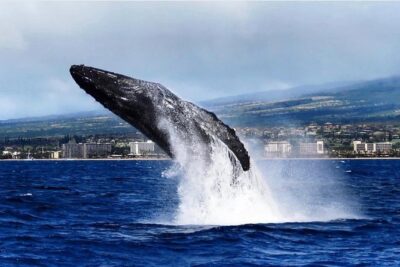
The season matters. This is a winter activity, and the amount of whale activity can vary from day to day. The tour includes a sighting guarantee, but that promise should not be confused with a guarantee of breaching, close approaches, or dramatic behavior. You are watching wild animals, not attending a scheduled show.
More things to do in Lahaina:
- Maui Eco-Raft Tour: Eye-Level Whale or Dolphin Watching – Lahaina
★ 5.0 · 2,482 reviews - Maui: Lahaina ATV Adventure
★ 5.0 · 1,582 reviews - Maui: Ultimate Whale Watch from Lahaina
★ 5.0 · 1,162 reviews
Leaving Lahaina on a low raft
The trip begins at 1223 Front Street in Lahaina, at the listed meeting point for the operator. Check-in has been described as quick, and the location is considered easy to find. The activity ends at the same place, so you do not need to arrange a separate return transfer.
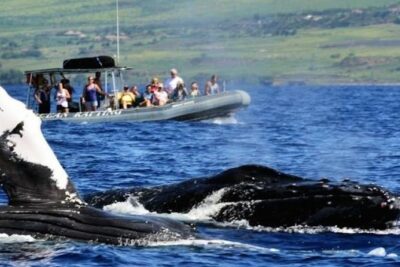
Once aboard, the raft gives you a low position near the water. That is a major part of the appeal. From this height, a whale’s back can feel impressively large, and a nearby blow is easier to appreciate than it can be from a high deck.
The design also provides 360-degree views. You may need to turn often and keep scanning, since whale activity can appear in different directions. That is part of the fun, though it means this is not a sit-back-and-forget-it outing. Keep your eyes moving and listen for instructions from the captain and naturalist.
The small format has practical value. A few people have reported riding with only eight passengers, far fewer than the maximum capacity of 20. With fewer bodies around you, it is easier to shift your view, ask questions, and hear the naturalist without competing with a large crowd.
How the two-hour search unfolds
The exact route depends on where whales are active, sea conditions, and the captain’s judgment. You leave Lahaina and head toward the Maui Nui whale sanctuary, watching the surface for blows and movement.
The crew may point out a group of whales, then position the raft so everyone has a fair chance to see. The captain’s job is not simply to race from one sighting to the next. The boat must be handled with care around the animals, and the whales decide how close the encounter becomes.
Past trips have included mothers with calves, escort males, several whales surfacing near the raft, and even whales passing beneath the boat. Those are outstanding possibilities, not standard promises. On a quieter outing, you might spend more time scanning, waiting, and learning about humpbacks between sightings.
That uncertainty is worth understanding before you book. The tour’s strongest advantage is the way it lets you respond quickly when activity appears. Its small size can provide a better line of sight and a more personal setting, but it cannot make whales breach or swim toward you.
Two hours is a sensible length for this type of outing. It gives you enough time to search and watch without taking up an entire day in Maui. Still, the time can pass quickly when whales are active. One person who had already taken many whale trips from Maui returned for a second outing two days later after a particularly strong experience.
The hydrophone changes what you notice
The hydrophone is one of the most distinctive features of this trip. The device goes into the water, and the whale sounds are carried through onboard speakers.
Surface sightings give you the visual drama: blows, tails, backs, and possible breaches. The hydrophone adds another layer, since humpback song is otherwise invisible from the boat. You may hear the low, haunting calls while watching the water where the whales are moving.
Sound quality depends on the whales, the equipment, and the conditions. You should not expect a constant concert. The value is in connecting the sound to the animals you are seeing and learning why underwater calls matter during the breeding season.
The naturalist also helps put the sounds in context. The crew members praised most often, including Renee and Brian, are described as animated, patient, and willing to answer questions. Names may vary by departure, but the role remains important: you get interpretation along with the sightseeing.
More whale watching trips from Maui:
- From Maalaea: Whale Watching Tour Aboard the Quicksilver
★ 4.5 · 1,280 reviews - WHALES GUARANTEED Maui Whale Watching Makai Adventures
★ 5.0 · 1,081 reviews - Ma’alaea Harbor: Whale Watching Tour Aboard Power Catamaran
★ 4.7 · 827 reviews - Maui: Whale Watching Cruise with Open Bar from Ka’anapali Beach
★ 5.0 · 802 reviews
What the crew adds to the trip
A captain and marine naturalist lead the outing. The best crew members combine safe boat handling with clear explanations, and that combination comes through strongly in the experiences associated with Will, Renee, Brian, and Joe.
Will has been praised for positioning the raft while keeping clear of the whales. Renee has been singled out for her enthusiasm and ability to explain the animals, the area, escort males, and mother-calf behavior. Brian and Joe have also received praise for answering questions and sharing information throughout the trip.
You should not book on the assumption that a particular crew pairing will be aboard. Staffing can change. But the repeated emphasis on both the captain and the naturalist is useful. This is not simply a boat ride where you are left to figure out what you saw after the fact.
A good naturalist also helps you stay realistic. If a whale surfaces far away, the crew can explain what happened and what signs to watch for next. If the raft moves toward another group, you learn why that group may be worth following.
Small boat does not mean unlimited closeness
The phrase small group can create the wrong expectation. A compact raft may give you a clearer view, faster repositioning, and a less crowded ride. It does not allow the captain to ignore wildlife protection rules or approach whales at any distance.
One disappointed passenger felt the raft remained about as far from the whales as larger commercial boats. That criticism is important to consider, especially since this trip costs $80.60 per person and larger excursions may cost less.
The value is not guaranteed closeness. The value is the combination of fewer people, a low water-level view, open sight lines, a hydrophone, and direct attention from the crew. On an active day, those features can make a major difference. On a slow day, the price gap may feel harder to justify.
The operator’s whale-sighting guarantee offers some protection against a completely empty trip. If whales are not seen, you can take another trip free. That helps with the basic question of paying for a search and seeing nothing, but it does not solve scheduling problems if you are leaving Maui soon.
Comfort, weather, and who should book
The raft is family-friendly for children age three and older, but it is not open to children under three or pregnant people. Service animals are allowed, and most people can participate according to the stated requirements.
Good weather is required. High winds and waves can cancel a departure, and safety must come before keeping the schedule. If that happens, you are offered another date or a full refund. Build some flexibility into your Maui plans if whale watching is a priority.
Rain ponchos are provided on wet days. Filtered water and paper cups are included, which reduces the need for single-use plastic bottles. Reef-safe sunscreen is also supplied, though I would still dress for sun, wind, and spray.
Alcohol is not included, but you may bring your own. Glass containers are not allowed. Keep your choices simple and practical for a small raft.
I would choose this trip for a couple, family, or small group that wants an active ocean outing with plenty of explanation. It also suits someone who has already seen whales from shore and wants the added perspective of being on the water.
I would think twice if you strongly dislike bouncing boats, need a high deck with lots of room, or expect guaranteed close encounters. A larger vessel may offer more space and a steadier feel, even if it lacks the intimate setup.
Is $80.60 a fair price?
At $80.60 per person, this is not the cheapest way to look for Maui whales. The price makes the most sense if you care about the small group, low raft profile, 360-degree views, and hydrophone.
The maximum of 20 people is already modest compared with large whale-watching boats, and actual groups may be smaller. That affects how quickly you can see, how easily you can hear the crew, and how much personal space you have when activity appears.
The tour also includes water, paper cups, reef-safe sunscreen, a marine naturalist, and the whale-sighting guarantee. These are useful inclusions, though none should overshadow the main reason to pay more: a more intimate boat setting.
I would call it good value on a day with active whales and a small passenger count. It is less compelling if your only goal is to see any whale at all, since lower-cost options may provide that basic opportunity. Book it for the format and interpretation, not just for the promise of getting physically closer.
Because it is typically booked about 26 days ahead, reserving early is sensible during the winter season. That is especially true if you need a particular date or want room to reschedule after poor weather.
Booking details that matter
You receive confirmation at the time of booking, and free cancellation is available if you cancel at least 24 hours before the start time. Cancel within 24 hours, or make a change inside that window, and the payment is not refunded.
The cutoff uses local Maui time. Check your schedule carefully before that deadline, especially if you are coordinating flights, a road trip, or another water activity.
The tour is offered in English. It begins and ends at the Lahaina meeting point, lasts about two hours, and allows a maximum of 20 people. Group discounts may be available.
Should you book this Lahaina whale tour?
I would book it if you want a short, focused whale trip with a small group, an onboard hydrophone, and crew who actively explain humpback behavior. The accounts involving mothers, calves, escort males, and whales passing near or beneath the raft show what a strong day can look like.
I would not book it solely because you expect the raft to approach closer than every other boat. Wildlife rules apply to all operators, and whale behavior can be quiet, distant, or unpredictable.
For the best chance of enjoying the format, leave space in your schedule for weather changes and book early in whale season. If the $80.60 price fits your budget, this is a worthwhile choice for an informative, low-to-the-water outing. If price matters more than group size and sound equipment, compare it with a larger boat before committing.
FAQ
How long is the whale-watching tour?
The tour lasts approximately two hours.
Where does the tour begin and end?
It begins at 1223 Front Street in Lahaina, at the listed meeting point, and ends back there.
How many people can join the raft?
The maximum group size is 20 people. Some departures may have fewer passengers.
Are whale sightings guaranteed?
The operator guarantees that you will see whales or receive the chance to take another trip free. The guarantee does not promise specific behavior such as breaching or swimming beneath the raft.
What happens if bad weather cancels the trip?
If poor weather causes cancellation, you are offered a different date or a full refund.
Can young children or pregnant people participate?
Children under three and pregnant people cannot participate. Service animals are allowed, and most travelers can take part according to the stated information.
More 2-Hour Experiences in Maui
- Maui: Two Hour Beginner Group Surf Lesson in Kihei
★ 5.0 · 950 reviews - Maui: 2-Hour Molokini Snorkel Trip
★ 5.0 · 816 reviews - 2 Hour Beginner Group Surf Lessons
★ 5.0 · 154 reviews - 2 Hour Private Group Surf Lesson in Lahaina Maui
★ 5.0 · 129 reviews
Just added around Maui
- Lahaina: Group Surf Lessons for Beginners★ 5.0 · 3 reviews
- Midmorning Whale Watch from Lahaina Harbor★ 3.5 · 3 reviews
- Clear Kayak Sunset and Glow Tour in Maui★ 3.5 · 3 reviews
- Professional Photographer in Maui★ 4.5 · 3 reviews
- The Ultimate Road to Hana Slingshot Adventure from Kihei Maui★ 5.0 · 3 reviews
- Private Airport Arrivals Rides to Hotel★ 5.0 · 3 reviews
- Brewery and Beach Cruise in a Vintage VW Bus★ 3.5 · 3 reviews
- Lahaina: Private Sunset Sailing Trip & West Maui Mountains★ 5.0 · 3 reviews
Whale Watching, compared.
Maui Eco-Raft Tour: Eye-Level Whale or Dolphin Watching – Lahaina
Read our review →
WHALES GUARANTEED Maui Whale Watching Makai Adventures
Read our review →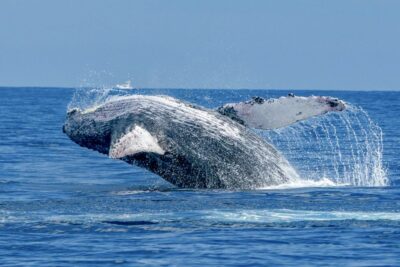
Whale Watching Cruise with Open Bar from Ka’anapali Beach
Read our review →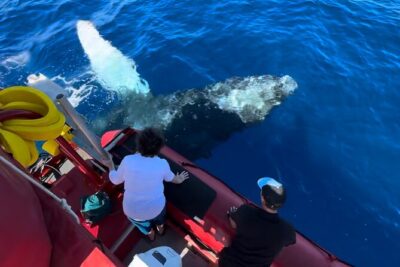
Browse the lists this tour appears in